

Preparing for BRCGS Certification with the Icicle Production Management Platform
BRCGS certification is one of the most important requirements for food manufacturers that want to supply major retailers. Food manufacturers operate under three layers of oversight: government regulations, retailer requirements, and specialty certifications.
Government regulations, such as FSMA in the U.S. and SFCR in Canada, establish the legal baseline for operation. Specialty certifications like Organic, Gluten-Free, Non-GMO, Kosher, and Halal help companies reach specific markets but remain optional.
Retailer-driven certification sits in the middle—and for most manufacturers, it is the most commercially important. Major grocery chains and global buyers require GFSI-recognized certification as a condition of doing business. Without it, suppliers cannot access many retail supply chains. For manufacturers with global retail ambitions, this is where BRCGS plays a critical role.
A and specialty certifications like organic or Kosher, there’s a third layer of requirements, one driven entirely by retailers and buyers. This is where GFSI-recognized certifications come in, and for manufacturers with global ambitions, BRCGS is the gold standard. With over 36,000 certified sites in more than 130 countries, BRCGS has set the benchmark for good manufacturing practices, playing a pivotal role in ensuring product integrity across international supply chains.
The Benefits of BRCGS Certification
According to BRCGS, certified businesses increase sales by an average of 7.5% and profitability by 6%, and the reasons are clear. Seventy percent of the world’s top 10 retailers—including Walmart, Tesco, Sobeys, and Costco—accept BRCGS certification.
Retailers, manufacturers, ingredient companies, and raw material processors around the world widely accept and specify BRCGS as part of their supplier approval processes. Researchers at Birkbeck, University of London, found that organizations that operate to BRCGS standards improve food safety, increase operational efficiency, drive commercial growth, enhance profitability, and foster broad-based innovation.
Expanding Market Reach with BRCGS Certification
Retailers do not require food safety certification without reason. The Global Food Safety Initiative (GFSI) established its framework to reduce food safety risks and build trust throughout global supply chains, placing legal liability and supplier accountability at its core. Today, more than 200,000 facilities across 180 countries hold GFSI-recognized certifications, reinforcing the value of certification programs. Retailers cite several key reasons for requiring certifications such as BRCGS from their suppliers:
- Certifications like BRCGS are a safeguard against liability claims
- Programs that focus on quality, in addition to food safety, ensure high-quality products
- BRCGS helps standardize requirements across their suppliers
- BRCGS helps avoid recalls and bad press
- Higher standards help build consumer confidence in the retailer’s brand
- Certification helps companies outsource expensive quality controls
For certified businesses, the payoff is measurable. A survey of over 800 GFSI-certified food processors across 21 countries found that nearly 90% believe certification benefits their food safety programs, and 74% would pursue it again even if no customer required it.
BRCGS certification carries international recognition of safe, quality food that leads to worldwide possibilities with the biggest retailers. The newest version, BRCGS Issue 9, reflects the growing demand for food safety culture, supply chain transparency, and unannounced audit readiness. So why not get this certification yesterday?
The reality is that BRCGS certification can be difficult to attain and maintain, with lots of paperwork, procedures, and ongoing surveillance audits. Icicle can make BRCGS certification much easier. Here is how.
Steps to BRCGS Certification
Becoming BRCGS certified is a structured process of eight steps:
- Learn about the BRCGS Code. Understand the requirements of BRCGS Issue 9.
- Register your company in the BRCGS Participate database.
- Secure leadership commitment. Establish food safety policy, objectives, and culture plan.
- Designate and train your food safety team. Explore BRCGS training courses.
- Develop a HACCP plan. Identify hazards, establish CCPs, and define monitoring procedures.
Implement a Food Safety & Quality Management System. Document procedures, supplier controls, and traceability. - Select a certification body. Obtain proposals and schedule an audit. Find an accredited BRCGS certification body.
- Complete certification audits. Stage 1 documentation review followed by Stage 2 facility audit.
Passing the initial audit does not guarantee continued certification. Certified sites must undergo ongoing surveillance audits, including at least one unannounced audit every three years. Companies must demonstrate at any time that they implement their documented systems in practice.

New Things to Know: Unannounced BRCGS Certification Audits and Food Safety Culture
BRCGS Issue 9 places renewed emphasis on two critical areas that go beyond traditional documentation:
Unannounced BRCGS Certification Audits
BRCGS offers flexibility in audit programmes. Certified sites may choose announced audits, blended announced audits, or unannounced audits, with the requirement that at least one unannounced audit occurs every three years for sites selecting the mandatory unannounced option. Companies must demonstrate at any time that they actively follow their documented systems, not just present them for audit day.
Food Safety Culture
BRCGS certification goes beyond documented procedures and requires organizations to embed food safety into everyday operations and culture. This includes leadership commitment, employee engagement, communication programs, and continuous improvement activities. Auditors look for clear evidence that food safety is more than just a policy in a binder.

How Icicle Prepares Your Company for BRCGS Certification
BRCGS certification increasingly recognizes the role of automation and software in maintaining robust food safety systems. The Standard requires that records be legible, accurate, and retrievable requirements that digital systems like Icicle are uniquely equipped to meet.
Whether your company is just beginning or needs a better solution to earn and maintain certifications, Icicle helps you through each step with integrated and time-saving features.
Leadership Dashboards
Real-time dashboards give leadership visibility into compliance metrics, training completion, and corrective actions across facilities. Management reviews become easier to prepare and more meaningful when data is always available.
“The transition to Icicle was seamless, and having everything in one system has made a huge difference. Audits are easier, traceability is faster, and we have better visibility into our operations.” – Maschanka Fernandez, Snow Cap Enterprises Ltd.
HACCP, TACCP, and VACCP
Icicle walks you through setting up HACCP, TACCP, and VACCP plans, step by step, so that you can satisfy food safety, food fraud, and food defense requirements. The intelligent system aggregates anonymized data to provide smart suggestions, which makes the whole process faster. By setting up your HACCP, TACCP, and VACCP plans in Icicle’s digital model of your facility, you benefit in the long term as your plans can change and grow easily with your company.”
Icicle walked us through the hazard analysis process and connected everything to our daily monitoring. Now when an auditor asks to see our CCP records, they are right there complete and verifiable.” – FreeYumm, as featured in our case study collection
Supplier Management
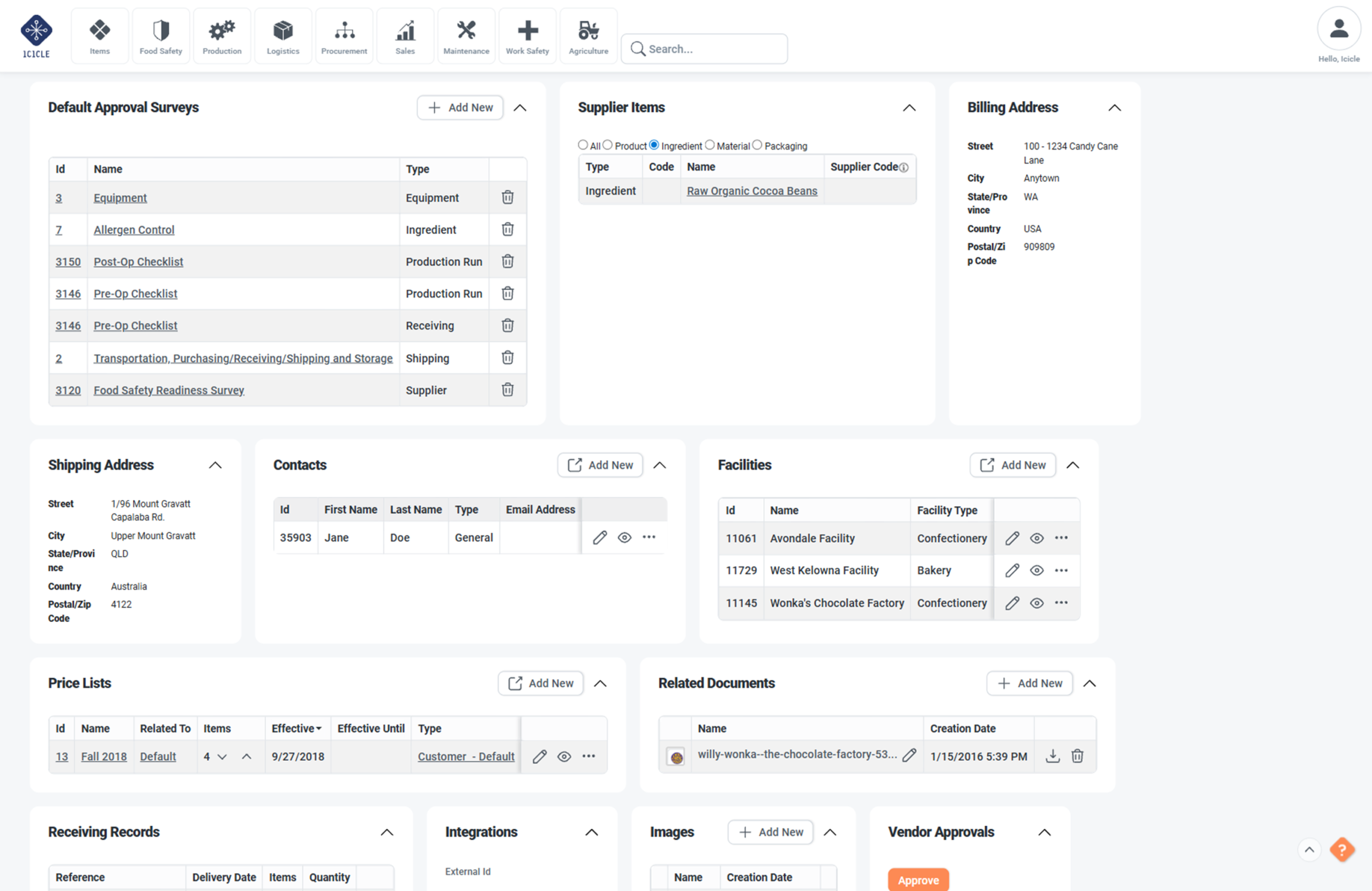
The Vendor Management feature checks for vendor certifications to ensure every ingredient entering your facility is as safe as possible. Supplier dashboards track Certificates of Analysis (COAs) and performance trends, supporting BRCGS certification requirements for supplier approval and monitoring programs.
Traceability and Recall Management
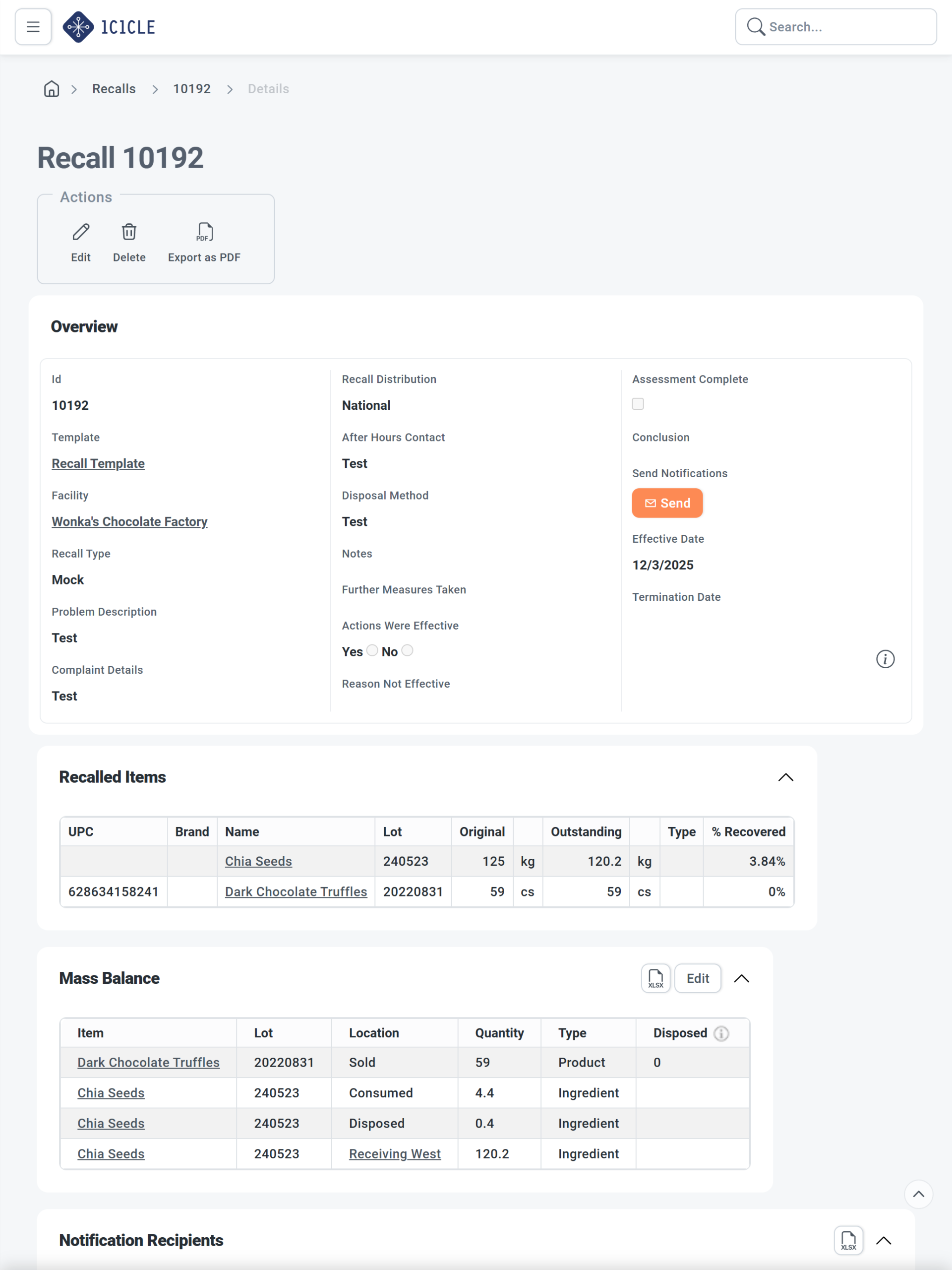
Enhanced traceability reports and automatic mass balance calculations identify exactly which lots contain which ingredients and how much of that ingredient remains in seconds. When responding to a potential recall or simply pulling up data during a re-certification audit, the speed and detail of Icicle’s traceability is unparalleled. This information is centralized and available on more devices than binder or spreadsheet systems.
Icicle users report that audit times have been cut 40% due to the readiness of thorough documentation and the ease of finding information. The ease of keeping records and finding them during audits is one reason Terry Goulah, Vice President of Operations and co-founder of allergen-free snack company FreeYumm, uses Icicle:
“To be honest, I do not think we could have achieved certification without Icicle. They were impressed that we could show them any information they wanted, like where those products went. From my standpoint, that made the audit go very smoothly.” – Terry Goulah, FreeYumm
Alerts
The most cost-effective way to prepare for audits, especially unannounced ones is to never find your company unprepared. Icicle helps you continuously maintain audit-ready standards so that you will never have to play expensive catch-up or fail an unannounced audit.
Icicle’s Alerts feature goes a long way toward preventing mishaps by notifying users of deviations at Critical Control Points (CCPs), like a refrigerator’s temperature rising above its operational limit, so that the problem can be corrected immediately. Other mandatory records, like sanitation logs and maintenance schedules, are readily accessible and, tied into the Alerts infrastructure, help employees stay on top of tasks before they become mistakes.
Real-time alerts are one of the reasons that Food Safety and Quality Coordinator Christopher Foster of recently certified company Ontario Pride Eggs finds Icicle’s automation a worthwhile investment:
“Our immediate return on investment for Icicle is real-time reporting that can capture non-conformities as they happen. If you receive real-time information and alerts, then you can act on it within minutes instead of hours and fix it before it becomes a problem. It is all on my dashboard; I can access Icicle through my computer, my tablet, or my phone.”– Christopher Foster, Ontario Pride Eggs
Incident Management
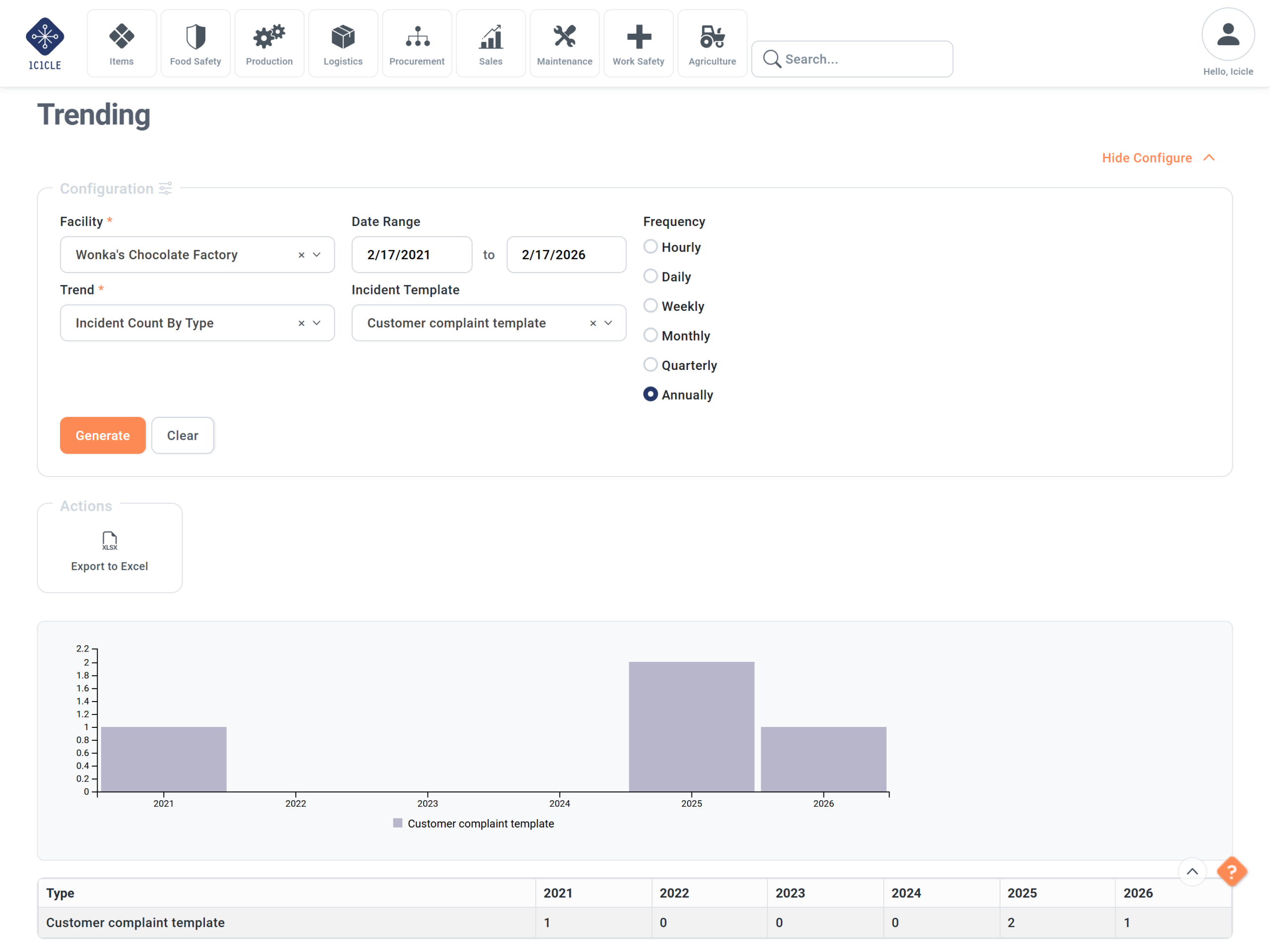
The Incident Management feature quickly allows your food safety team to launch an incident and reference suggested corrective actions. Root cause analysis and preventative measures can be added to the CCP’s plan. Employees can be flagged for retraining if necessary, and documents can be flagged for review creating a complete audit trail for any non-conformance.
Task Management and User Teams
Any task, whether day-to-day preventive maintenance or one-time assignments like a major equipment overhaul, can be assigned to individuals or teams through the Task Management feature. Integrated with Incident Management and Alerts, supervisors can monitor and be certain that corrective actions have been taken to fix any problem and maintain readiness.
Virtual Audits by Remote Access
During certification or surveillance audits, your food safety team can grant the auditor secure online access to facility documents. This builds trust and transparency while minimizing the time auditors need to spend on-site.
Automated Traceability
Enhanced traceability and automatic mass balance calculations identify exactly which lots contain which ingredients, and how much of that ingredient remains and does so in seconds. When responding to a potential recall or simply pulling up the data during a re-certification audit, the speed and detail of Icicle’s traceability is unparalleled.
The Bottom Line: BRCGS Certification with Icicle
BRCGS certification is more than a compliance checkbox; it is a signal of operational maturity. It tells retailers, partners, and customers that your food safety systems are not just documented, but deeply embedded in how you work every day.
With Icicle, food businesses can move from scrambling for audits to confidently demonstrating their safety systems. You will gain access to new markets, build trust with buyers, and free your team from paperwork to focus on what really matters: producing safe, high-quality food.
With Icicle, you will meet every BRCGS requirement while saving time, reducing errors, and staying audit-ready 24/7.
Request a demo of Icicle today and check out our Case Studies here.
For more insights into food safety certification, explore our guides to SQF certification, FSSC 22000 certification, and CanadaGAP certification.
Frequently Asked Questions: BRCGS Certification
What is BRCGS certification and who needs it?
BRCGS (British Retail Consortium Global Standards) is a GFSI-recognized food safety standard used by over 36,000 certified sites in more than 130 countries. If you supply food or food ingredients to major retailers, Tesco, Walmart, Costco, Sobeys, there’s a good chance they already require it, or soon will. It applies to food manufacturers, ingredient producers, and packaging suppliers who want to access global retail supply chains.
What is the difference between BRCGS Issue 8 and Issue 9?
Issue 9, released in 2022, introduced stronger requirements around food safety culture, not just documented procedures, but evidence that food safety is genuinely lived day-to-day in your facility. It also tightened unannounced audit requirements and placed greater emphasis on food fraud prevention and supply chain transparency. If you’re still operating under Issue 8 procedures, you’re overdue for a review.
When is BRCGS Issue 10 coming and what should I expect?
BRCGS opened its official public consultation for the next revision of the Global Standard for Food Safety in January 2026, the first formal step toward Issue 10. Based on how previous revisions have progressed, industry experts anticipate publication around mid-to-late 2027, with a transition period before mandatory implementation. Early signals suggest Issue 10 will build on Issue 9’s foundations rather than overhaul them, expect continued emphasis on food safety culture, stronger environmental monitoring requirements, and tighter expectations around consistency between what’s documented and what’s actually happening on the floor. If you’re currently working toward Issue 9 certification, that’s exactly where your focus should stay. Getting Issue 9 right is the best preparation for whatever Issue 10 brings.
How long does it take to get BRCGS certified?
Most facilities take three to six months to prepare for their first BRCGS audit, depending on how mature their existing food safety systems are. If your HACCP plans, traceability records, and supplier controls are already well-documented, you’re closer than you think. The bottleneck for most companies isn’t knowledge, it’s paperwork. That’s exactly where a system like Icicle cuts the timeline down.
What happens if you fail an unannounced BRCGS audit?
A failed unannounced audit is serious, it can mean suspension or withdrawal of your certificate, which puts your retail contracts at risk. The most common reason companies fail isn’t that they’re doing something unsafe; it’s that their records don’t reflect what’s actually happening on the floor. Real-time digital monitoring closes that gap. You can’t fake compliance at 2am on a Tuesday, which is exactly why continuous audit-readiness matters more than pre-audit scrambling.
Can small food manufacturers get BRCGS certified?
Yes, BRCGS is designed to scale. Whether you’re a 10-person artisan producer or a multi-site operation, the standard applies the same core principles. Smaller sites often find the documentation burden the hardest part, since they don’t have dedicated food safety staff. Digital tools that automate routine record-keeping make certification achievable without adding headcount.
How does Icicle specifically support BRCGS Issue 9 requirements?
Icicle is built around the same principles BRCGS Issue 9 enforces: real-time records, auditable HACCP plans, traceable lots, and documented corrective actions. Leadership dashboards support the food safety culture requirements. Automated alerts handle CCP deviations. Supplier management tracks COAs. And when an auditor shows up unannounced, everything is already there, no frantic binder-hunting required. Icicle users report cutting audit preparation time by up to 40%.